Two offers, ten minutes apart, on one drive home.
Both cards were read out loud at forty-five miles an hour on 2026‑09‑09. The phone heard them, the arithmetic ran against a real fuel baseline, and both were called before the batch was gone. Every figure below came out of the ledger, not out of a mockup.
$41.34, 4 stops, 28 miles, 1 hour, 9 minutes.
| The offer | Pay | Fuel | Net | Margin | Take-home | Call |
|---|---|---|---|---|---|---|
| 28 mi / 69 min | $41.34 | $5.10 | $36.24 | 87.67% | $31.52/hr | TAKE |
| 2.8 mi / 27 min | $7.50 | $0.51 | $6.99 | 93.21% | $15.53/hr | PASS |
Look at the second row. Ninety-three percent margin, and it is still a no — because ninety-three percent of $7.50 is $6.99, and it costs twenty-seven minutes of a shift to earn. A margin percentage flatters a small offer. The clock never does. Pay-per-mile, the rule every other Spark app is built on, cannot tell these two rows apart at all.
Their estimate has no ground time in it.
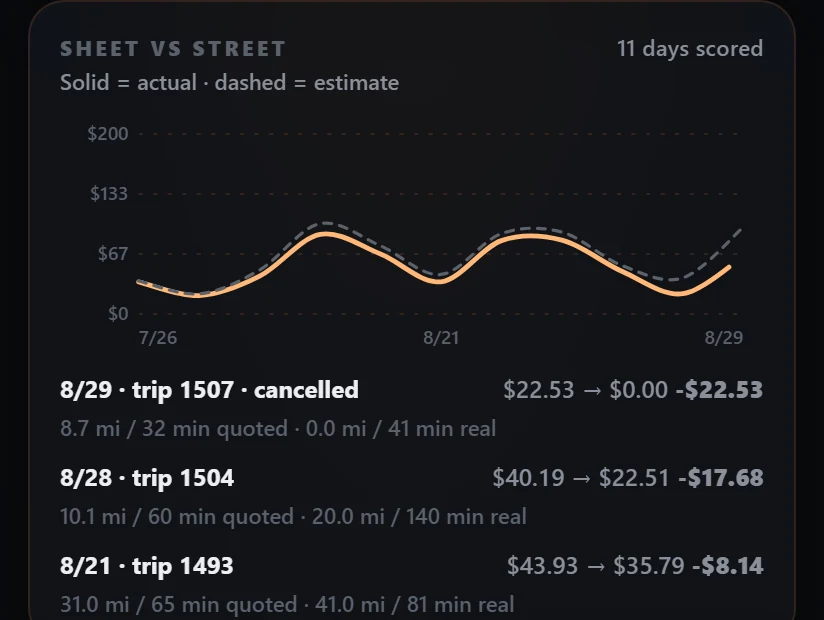
We put one real shift's clock against what the app promised. The driving legs came in almost exactly on the estimate. Four of the eight were impossible to finish in the time given, because the schedule never counted a minute of standing still — every spare minute in it was sitting at the store, waiting on a load nobody pays for.
That is the number Atlas is built to catch, and it is why an hourly floor is not optional.
Minutes of slack in the schedule, one measured shift, 2026-08-28. Negative means the schedule left less time than the drive takes.
→ OPENED trip 76, in progress — the day’s mpg 23.3 and gas $4.24 are sealed onto it, read back off the row
Pro chat. Tap the strip and the receipt slides up.
One sentence, out loud, and a receipt for everything it touched.
Read the offer out the way you would say it to someone in the passenger seat — mangled, half a sentence, engine running. Atlas hears it on the phone itself and answers in a single line you can take in at a glance.
And when it does not know something, it asks. Walmart leaves the clock off plenty of offers. Atlas will not invent one to fill the gap; it asks how long they are saying, because a made-up number in your ledger is worse than no number at all.
Every tool it runs leaves a mark. The little icons over a reply are drawn by the server from what actually ran — 💵 scored an offer, 📊 touched your ledger, 🚚 logged a trip, 💭 its reasoning is attached. Atlas cannot type one into being. Tap them and you get the receipt: what it did, when, and what the database said back.
Your whole shift, on one screen.
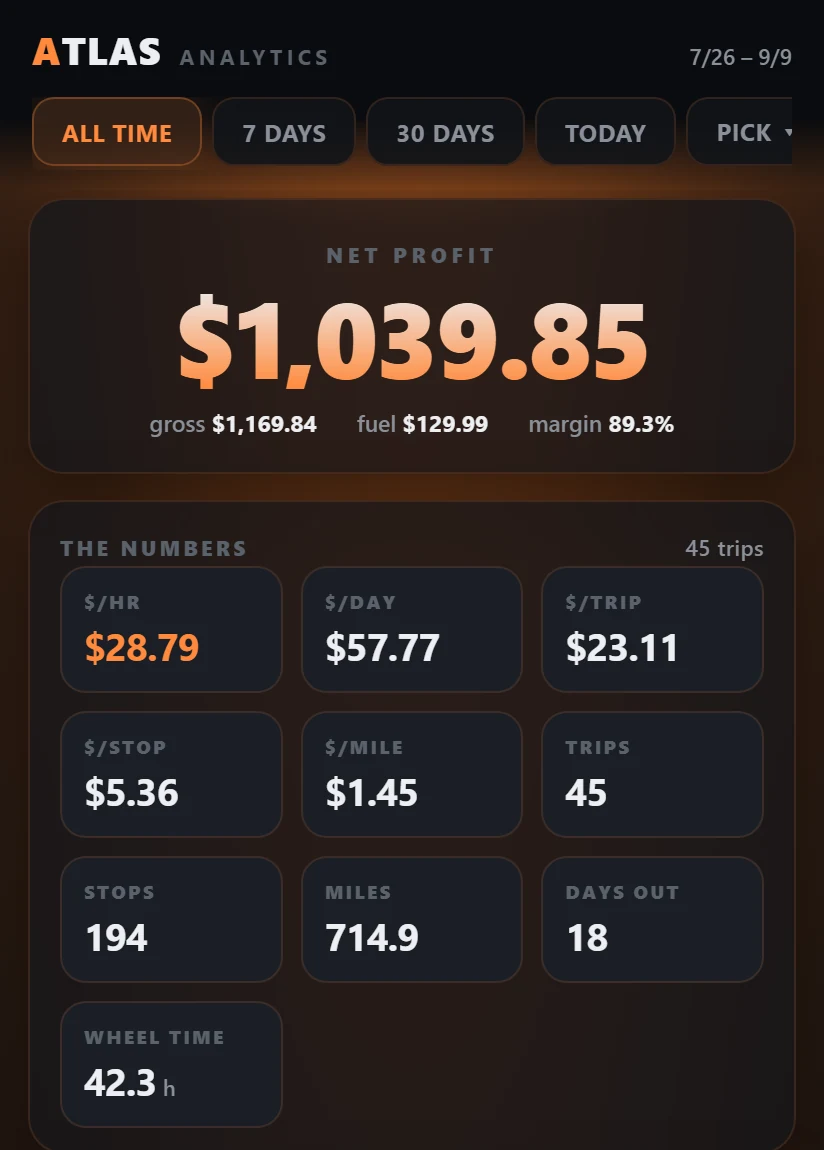
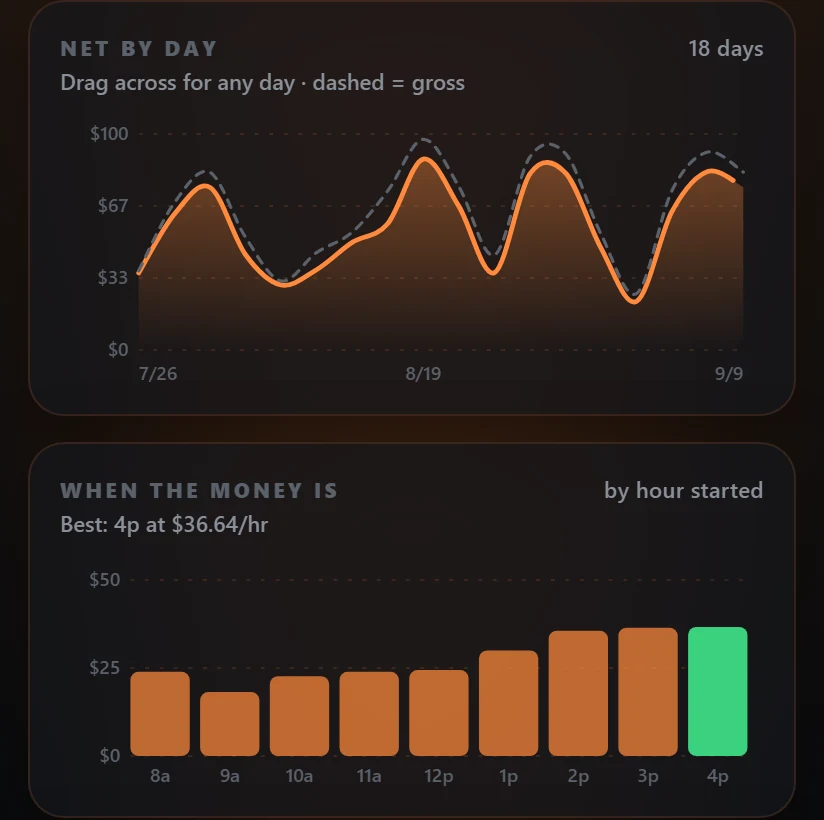
This is the Pro Dash, rendered by the app’s own code over one real driver’s ledger — 45 trips, late July to early September. Nothing on it was typed into a mockup. Every figure is computed on the server off the rows the copilot logged.
Free is not a trial. It is the whole margin caller.
The arithmetic that decides take or pass is identical on both tiers and is never touched by what you pay. What changes is how much you have to type.
Free
bring your own key, ad supported
- The full margin caller. Real fuel cost off your MPG and today's gas price, margin, take-home rate, take or pass.
- Both floors are yours. Set your margin floor and your hourly floor to whatever your market actually pays.
- Speech runs on your phone. The listening happens on the handset itself, so talking to it costs you nothing.
- Nothing is written down. The math runs, you get the answer, and no row is kept.
- Estimated numbers only — what the offer claimed, not what the day did.
You bring a free Google AI key, it stays on your phone, and it never reaches our server. Free costs us nothing to run, so it is not going anywhere.
Pro
bring your own account, no ads
- Everything in free, and it stops being a form.
- Estimated against actual. What the offer promised next to what the shift really did. The gap is the whole point.
- You talk, it logs. Odometer at the lot, the store wait, the pay that actually landed. No forms at a curb.
- The Dash. Net, real hourly, per stop, per mile, when the money is, and what every offer promised against what it paid.
- It remembers. The conversation stays, and it keeps a short log of how you work so you are not repeating yourself every shift.
- Your day on a map. Coming later.
Pro runs on a subscription you already hold and bring with you. We do not resell it, we do not mark it up, and we never front the bill — which is exactly why we can hand you the good model instead of the cheap one.
What we deliberately do not hold.
Every line here is something the app was built not to do, and each one cost a feature to keep.
Your key stays on your phone
There is no key column in our database, encrypted or otherwise. The trade is real and we took it on purpose: the server can never score an offer while your app is closed.
Nobody sees your name
On the driver forum you are Spark Driver 41827, or whatever five digits the
database picks. Random, permanent, not your sign-up order. Drivers get deactivated for
what they post; a forum where you can be identified is a forum where nobody says the
true thing.
The math never bends
Your floors move where the line gets drawn. They never touch the fuel cost, the margin or the rate. Two drivers looking at one offer see the same numbers and are free to disagree about them. That is the design.